
Enterprise People Directory Choices
Enterprise people directories are spread across Clark County and Nevada institutions. That is a feature of local government, not a missing town database. Enterprise is an unincorporated town, so Clark County publishes the useful civic rosters and keeps the property, deed, planning, and business records. Education directories belong to the Clark County School District, the University of Nevada, Las Vegas, and the College of Southern Nevada. Archives and libraries hold the older sources.
| Directory source | People or roles listed | Keeper | How to consult it |
|---|---|---|---|
| Enterprise TAB roster | Board members and county liaison | Clark County | Current page, agendas, minutes, audio |
| County contact pages | Officials, departments, public contacts | Clark County | Decentralized web pages and main lines |
| CCSD staff pages | School administrators, teachers, support staff | CCSD and each school | District and school web pages |
| UNLV and CSN directories | Faculty and staff | Each college | Public name and department searches |
| Assessor owner roll | Owners, trusts, and entities | Clark County Assessor | Free current search |
| Clark County voter files | Registered voters, districts, participation | Clark County Elections | Weekly files with confidential entries suppressed |
| License and entity indexes | Licensees, officers, managers, agents | Nevada boards and Secretary of State | Official status searches |
| Telephone and university directories | Past subscribers, faculty, staff, students | UNLV Special Collections | Verified archival runs and finding aids |
Start with the kind of relationship that should exist. A county contact page can confirm a public role. A campus directory can connect a name with a unit. The owner roll identifies the person or entity assessed for a parcel, not every occupant. Clark County voter files work as electoral rosters, not residential phone books, and suppress protected entries. For a past resident, use a dated telephone book, school item, census schedule, newspaper, or recorded property chain. These sources answer different questions, so a name in one should not be stretched into a broader claim.
Enterprise County Staff Directories
Enterprise has no city directory because it has no incorporated city government, city clerk, or municipal staff. The Enterprise Town Advisory Board roster is the most local official list. It names the appointed board members, gives meeting material, and identifies the county liaison. Agendas and backup packets can also name planners, applicants, representatives, and project contacts. Those entries document participation in a public matter. They are not a resident roll.
County departments publish contacts on their own pages rather than through one complete employee search. The same decentralized rule now applies at state level: Nevada removed its central public employee directory. Use the relevant agency roster or department main line instead of an old phone-book link. If a person is absent, identify the department by function, call its public number, and ask for the correct unit.
The Clark County department contact page shows the type of county route available for Enterprise directory questions.
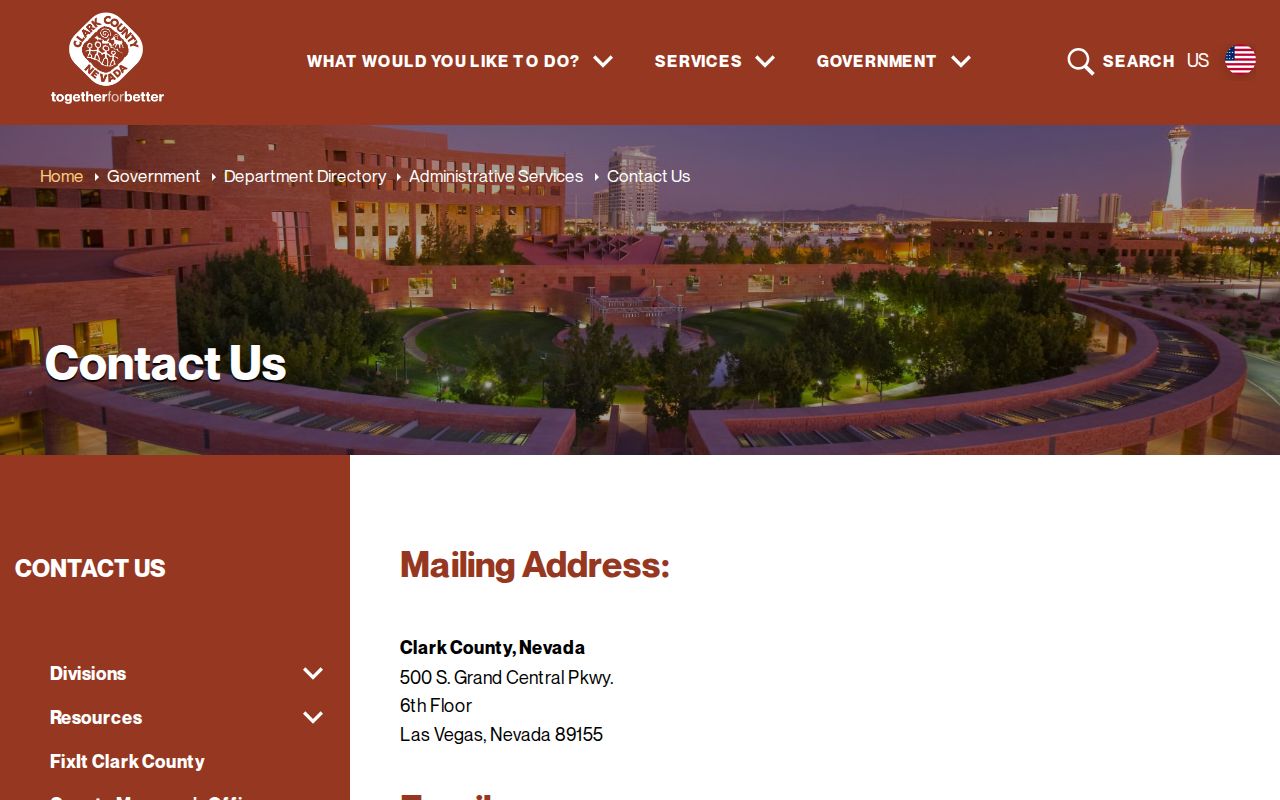
That county structure explains why a Clark County department, rather than an Enterprise city office, is the right starting point.
Search Enterprise Education Directories
School and college tools are the strongest current people directories for education roles near Enterprise. CCSD school staff pages may accept a keyword, first name, last name, and department. A representative page grouped entries under teaching, office, speech, staff, and administration categories, though each school may implement its list differently. Entries can show a display name, title, department, and institutional email. Duplicates can appear in feeds, so confirm a role with the school office.
The UNLV Employee Locator is broader. It permits name, supervisor, and position-group searches, and its primary-position data is refreshed from Workday each business day. The College of Southern Nevada directory offers a person-name field, a department filter, and alphabetic browsing. Result cards may contain a name, role, department, and phone.
| UNLV search field | Input style | Useful detail |
|---|---|---|
| First Name | Text | Up to 40 characters; letters, numbers, hyphens, spaces |
| Last Name | Text | Allows a broad or specific surname search |
| Supervisor Name | Text | Up to 60 characters |
| Position Group | Dropdown | Faculty, classified, contingent, postdoctoral, and resident groups |
The UNLV Employee Locator presents these fields on one public form.
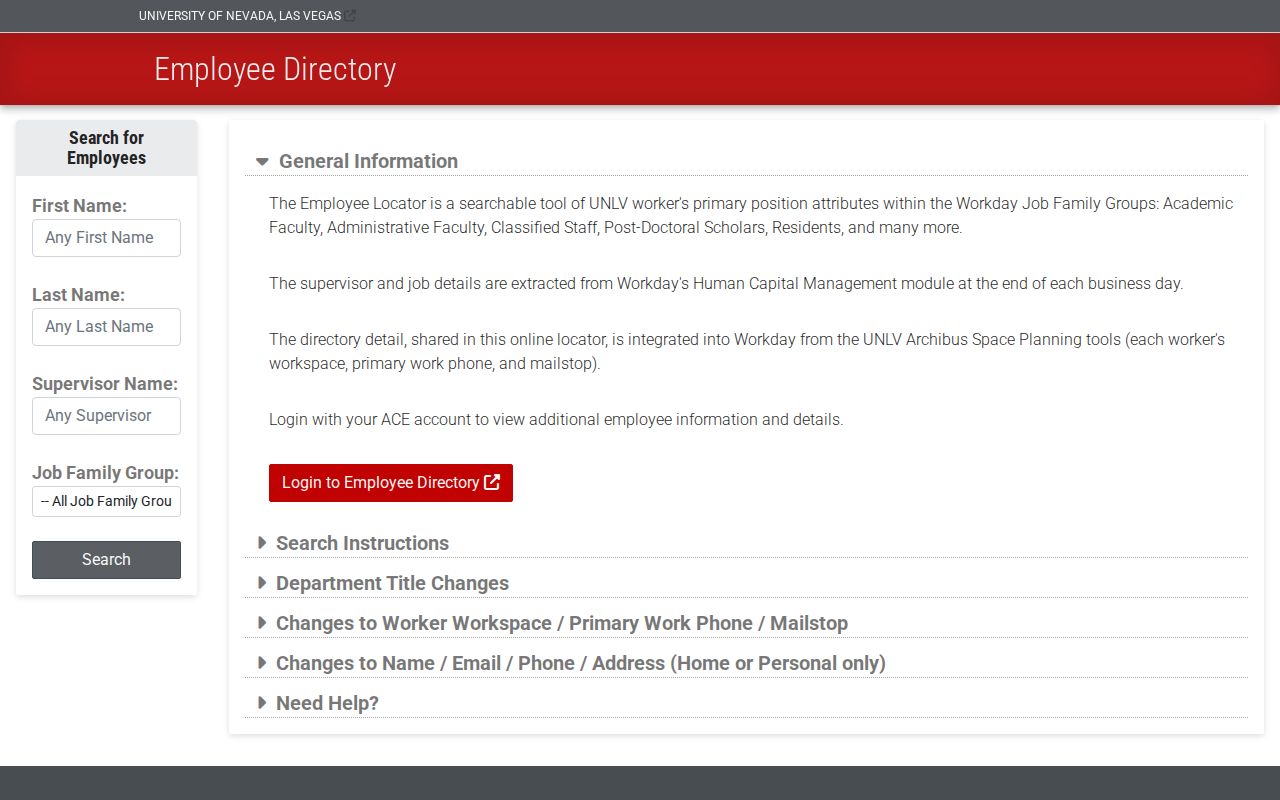
Searching by position group can find the right unit even when the exact spelling of a name is uncertain.
Enterprise Directory Entry Details
A public staff result is a work-role record. The exact fields vary by institution and by the worker's position. A verified UNLV academic-unit entry included the fields below, but other entries may omit some of them. Treat each visible item as current institutional contact data and confirm it on the unit roster before relying on it.
| Name and credential | Display name and any published academic credential |
|---|---|
| Role | Position title and leadership duty, when listed |
| Unit | Department or academic program |
| Office | Campus building and room, when public |
| Mail code | Internal campus routing code |
| Contact | Institutional phone and email, when supplied |
| Profile | Link to a longer faculty or staff biography |
A title can change sooner than an archived page. Compare the central result with the department roster, then use the public unit number if the two disagree. An institutional directory does not establish a private address, family connection, or off-campus identity.
Note: Directory fields vary across departments, so a blank field does not prove that no public contact exists.
Enterprise Property Owner Directories
The Clark County Assessor roll acts like an owner directory for Enterprise parcels. Its Real Property Records menu supports owner name, address, parcel number, subdivision, subdivision owners, parcel type or book and page, a parcel tree, and map inquiry. A parcel detail may show the assessed owner, tax-mailing address, physical situs address, APN, legal description, tax district, values, sale references, and map links. Situs means the physical parcel address. An APN is the county's parcel identifier.
Owner and occupant are not synonyms. A trust, business, or distant owner may appear on the roll, while a renter will not. For title context, carry the APN or owner name into the Recorder name index. Recorded parties are tied to deeds, liens, releases, and other instruments. The index does not turn each party into a current resident.
Read the role. A directory result proves only what its keeper records, such as assessed owner, recorded party, public employee, or licensed professional.
Enterprise Business License Directories
Official professional and business directories can verify a role or status. Enterprise falls under Clark County business licensing because the town is unincorporated. Nevada boards separately maintain searches for attorneys, physicians, nurses, contractors, real-estate licensees, cosmetologists, and educators. Most accept a name or license number. Results may include license type, current status, issue or expiration dates, and public discipline, but each board exposes a different field set.
The Nevada license search directory routes users to the proper regulator. For organizations, the SilverFlume entity search can show a legal entity name, type, status, filing dates, Nevada business ID, registered agent, officers or managers, and filing history. The Clark County Clerk's fictitious-firm-name index is separate. A trade name is not the same record as a state entity.
Business and license addresses may identify an office, registered-agent address, or mailing point. They should not be described as a person's home without support from the record itself.
Note: Check a status result with the board that regulates the profession, since field coverage differs by license type.
Enterprise Directory Years That Matter
Local coverage changes sharply by year. Clark County began in 1909, and the Recorder says its microfilm starts with the county. The public online official-record index begins in 1988. That boundary marks digitization, not destruction. Older recorded names remain available through microfilm rather than the modern web form.
A later custodian change matters too. Marriage recording moved from the Recorder to the Clark County Clerk on July 27, 2015, while the Clerk's certificate search spans 1909 to the present. The index can be searched, but certificate images are not displayed online.
- 1861 to 1882
- Nevada Territory city directories survive on four microfilm reels at UNLV.
- 1909
- Clark County's recorded-document microfilm run begins.
- 1963 to 1966
- UNLV holds a verified Southern Nevada telephone-directory series.
- 1964 to 1965
- A verified UNLV institutional directory item covers faculty, staff, and students.
- 1988
- The Recorder's online official-record index begins.
Enterprise grew mainly in the modern Las Vegas era. Earlier residents may be filed under Clark County, Las Vegas Valley, a subdivision, a ranch, a school, or a township label instead of Enterprise. The date and place label should guide the directory choice.
Note: Online coverage dates mark a portal's reach, not the first year the underlying record series exists.
Enterprise Library History Directories
Enterprise has no verified town-specific city-directory run. The reliable fallback chain begins with the Las Vegas-Clark County Library District catalog, then moves to UNLV Special Collections and the Nevada State Archives. Exact Polk or reverse-directory volume years were not published on one official Library District page, so each title and year must be confirmed with the catalog or reference staff.
| Historical source | Verified span | Repository | Best use |
|---|---|---|---|
| Nevada Territory city directories | 1861 to 1882 | UNLV Microforms | Early residents, firms, officials |
| Southern Nevada telephone books | 1963 to 1966 | UNLV collection MS-00601 | Subscriber and address checks |
| UNLV institutional directory | 1964 to 1965 item | UNLV collection UA-00117 | Faculty, staff, student cohort |
| Newspapers and genealogy databases | Title-specific | Library District | Obituaries, notices, family history |
The Library District lists Ancestry Library Edition as one in-library genealogy route.
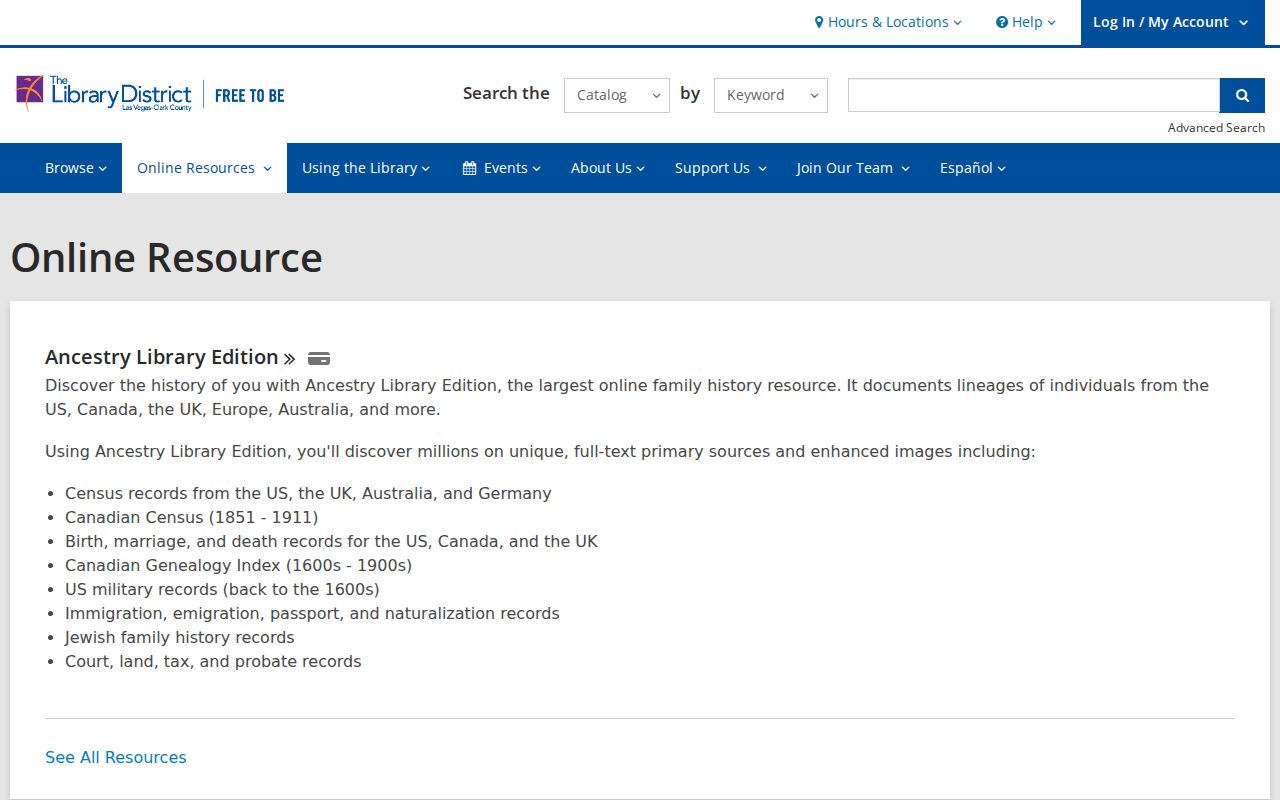
Access may depend on an eligible library location, while archival books or microfilm can require a staff request or on-site visit.
Enterprise Directory Geography
A Las Vegas postal city does not prove that an address lies inside incorporated Las Vegas. Enterprise occupies part of the southwest valley and uses Las Vegas mailing addresses. County GIS, the APN, and the tax district can settle which public body keeps the related record. Neighborhood names such as Silverado Ranch, Southern Highlands, and Mountain's Edge can also appear where an Enterprise label does not.
Historical research benefits from the same flexibility. Search a known surname with a street, subdivision, school, civic group, or household member. Compound surnames, hyphens, initials, prior surnames, and trust or business variants can change index results. For a past address, pair a verified phone book or yearbook with census neighbors, newspapers, and the property chain. The 1950 census is the newest released decennial schedule at the research date.
Note: A place label helps select a keeper, but it does not by itself prove residence, ownership, or identity.
Limits of Enterprise People Directories
No authoritative current residential white-pages directory was found for Enterprise. Mobile-only households and unlisted subscribers make modern phone books incomplete in any event. The state's central employee roster was removed, and no Enterprise-wide public HOA, alumni, congregation, club, chamber-member, union, or neighborhood directory was verified. Those collections may be private, restricted to members, or donated to an archive years later.
Community and archival rosters require careful context. A meeting packet shows who appeared in a dated civic matter. A yearbook places someone at an institution for a school year. A cemetery index or obituary can support a family-history trail, but contributor-made entries should be checked against a cemetery, death record, funeral notice, or newspaper. For broader access-law and copy-request rules, consult the Enterprise public records overview.
Use people directories for lawful personal research, genealogy, civic transparency, reconnecting, and estate work. Do not use public contact details to stalk, harass, intimidate, or harm anyone.